

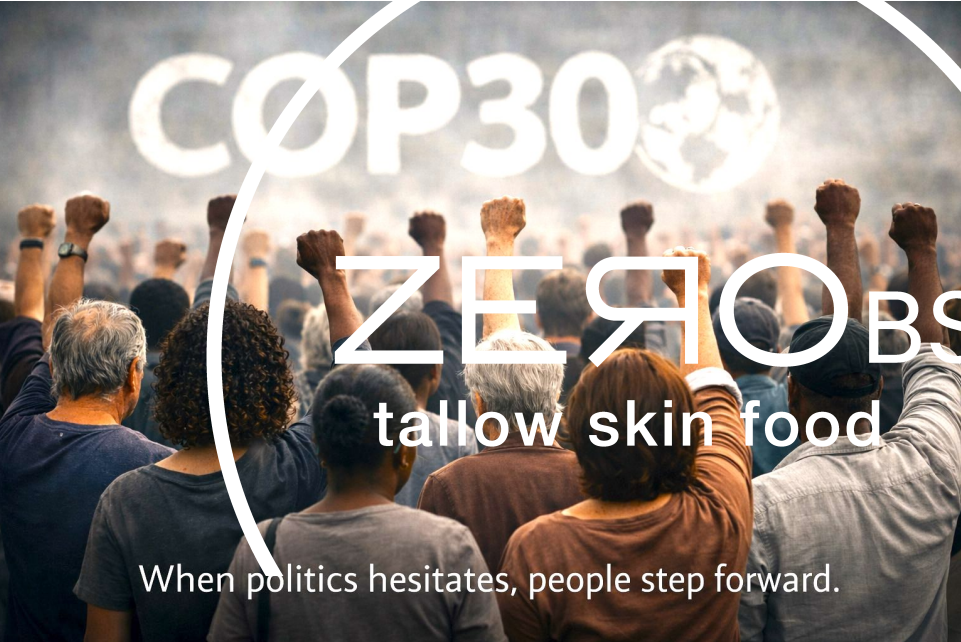
COP30: Why Fossil Fuels Still Shape Skincare
If You Missed What Happened at COP30, This Is Why It Matters to the Skincare Industry
COP30 is the 30th United Nations climate conference, bringing together governments to
negotiate global climate action. This year in November, COP30 was supposed to be the turning point.
Early in the summit, more than 80 nations — across Africa, Asia, Latin America, the Pacific,
Europe — stood together and demanded something historic:
A global, measurable, enforceable roadmap to phase out fossil fuels.
For a brief moment, the world saw what courage looked like. A draft message sent to the world’s press called for a fossil-fuel phase-out — But then the politics kicked in.
And just like that, COP30 backtracked.
What began as a bold call to end fossil fuel dependency ended in a watered-down, voluntary, almost symbolic agreement — with no binding phase-out, no deadlines, and not even the phrase “fossil fuels” in the final text. The world asked for courage; greed and self-interest prevailed.
When Governments Won’t Protect You, What Do You Do?
While COP30 faltered and diluted its own fossil-fuel phase-out language, the consequences of political hesitation are no longer theoretical. They reach into energy, food, housing — and quietly, into everyday consumer products, including skincare.
Skincare is one of the least scrutinised yet most fossil-fuel-dependent consumer industries, built on petroleum derivatives that are applied daily, washed into waterways, and absorbed into our bodies without question.
When global climate talks fail to lock in meaningful commitments, industries take it as permission to continue business as usual. And in skincare, “business as usual” means this:
- Petrolatum
- Petrolium gel
- Mineral oils
- Silicones
- Petrochemical preservatives
- Petroleum derived vitamins
- Synthetic fragrances
- Plastic packaging
- And marketing campaigns pretending this is “clean,” “green,” or “conscious”
Let’s stop pretending. The beauty industry is still built on fossil-fuel by-products. And COP30’s retreat gives brands one more excuse to keep it that way.
Zero BS is not waiting for permission
- We eliminated petrochemicals before we started manufacturing.
- We resisted preservatives and synthetic fragrances.
- We rely on regenerative, edible-grade ingredients because they make sense for the skin and the planet.
- We built the roadmap COP30 couldn’t agree to. This isn’t virtue signalling. This is what responsible citizenry looks like.
When Accountability Moves Beyond Politics
While COP30 faltered and diluted its own fossil-fuel phase-out language, citizens around the world are losing faith in political inertia — and they’re going to court.
In Japan this week, hundreds of citizens filed a lawsuit against their central government, accusing it of unconstitutional climate inaction that endangers their health and livelihoods. They’re seeking damages and asking the courts to hold the state accountable for failing to protect them from increasingly extreme heat and climate harms. Climate accountability is no longer just an environmental talking point — it’s becoming a legal and moral imperative.
A call to the skincare industry
If 80 nations had the courage to demand a fossil-fuel phase-out, then skincare brands can do better than petroleum-based products. So here is the challenge — direct and unavoidable:
- Stop hiding petrochemicals behind soft marketing.
- Stop calling petroleum "skincare."
- Stop treating sustainability as a packaging decision.
- Start reformulating with ingredients that belong in a post-fossil-fuel world.
COP30 blinked. We don’t have that luxury. The transition away from fossil fuels will happen—with or without political courage. And the brands that evolve now will be the ones left standing.
Zero BS already stepped into the future. It’s time for the rest of the industry to catch up.



1 comment
I love the deodorant stick I was very allergic to any amines in deodorants. Zero BS leaves me with a soft underarm feel
Great product
Hans Middelhoven
Leave a comment
This site is protected by hCaptcha and the hCaptcha Privacy Policy and Terms of Service apply.